
When Rotary Table Workflow Makes Sense for Insert Molding
Understand when rotary table workflow helps insert molding production by separating loading, molding, cooling, and unloading into repeatable stations.
2026-07-07 | 7 min read | Category: Production Insights
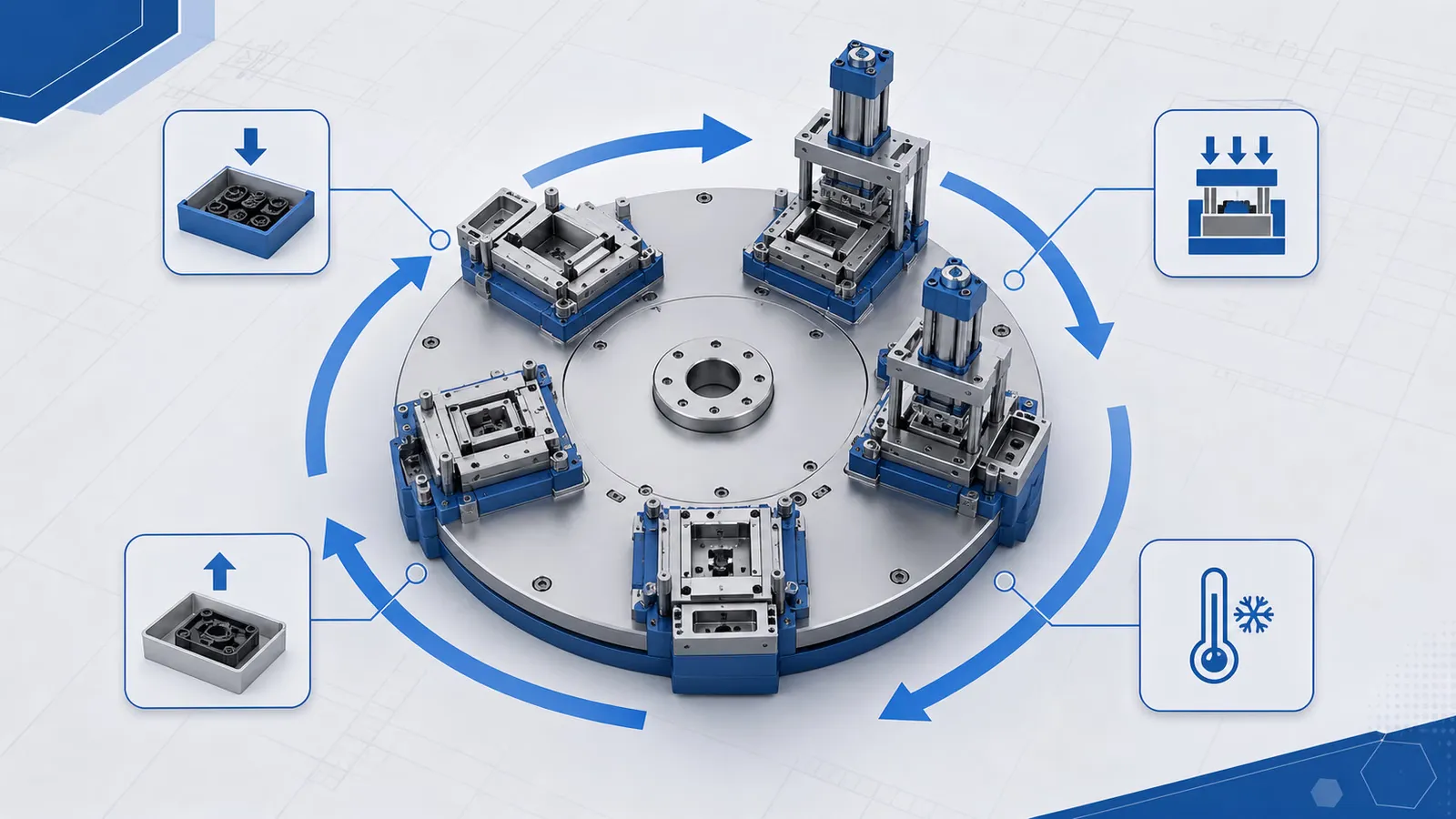
Rotary table workflow makes sense when insert loading, molding, cooling, and unloading can be separated into repeatable stations. The value is not just movement. The value is parallel work: while one station is molding, another station can be loaded or unloaded. This can reduce waiting time when the process is designed around station-based production.
The machine category page is rotary table machines.
Think in Stations, Not Only in Machines
A rotary table machine should be discussed as a production cell concept. Each station has a job. One station may be for insert loading, one for molding, one for cooling or holding, and one for part removal, depending on the mold and table design. The station concept must match the product and workflow.
If the operator needs time to place inserts carefully, station-based work can help. If inserts are simple and loading is very fast, a rotary table may add complexity without enough workflow benefit. The decision starts with the process, not the table name.
Good Conditions for Rotary Table Discussion
Rotary table workflow is worth discussing when:
- Insert loading is repeated and predictable.
- The product can be fixtured clearly at a loading station.
- The mold concept supports indexed movement.
- Loading and molding can happen in parallel.
- The project needs a stable production rhythm rather than a single-position workflow.
Common discussion areas include insert molding, electrical components, small industrial parts, and products where multiple inserts must be prepared consistently.
When Slide Table May Be Enough
Rotary table is not automatically required for every higher-output project. A slide table machine may be enough when the main need is better operator access outside the clamping area. A double slide table can also support alternating loading and molding for some workflows.
The difference is the production rhythm. Slide table is usually discussed around access and alternating work. Rotary table is discussed around multiple stations and repeated indexing.
Automation Planning
Rotary table layouts often create clearer positions for automation, but automation should not be assumed. If automatic insert feeding, part removal, or inspection is expected, the machine discussion should include fixture access, robot approach direction, signal exchange, guarding, and maintenance access.
The related machine category is automation-ready vertical molding machines. Automation readiness depends on project scope and should be reviewed early.
Questions for a Rotary Table Inquiry
Before requesting a rotary table recommendation, prepare:
- Number and type of inserts.
- How inserts are oriented and held.
- Whether loading is manual or automated.
- Whether the part needs cooling or holding after molding.
- How finished parts are removed.
- Whether the mold concept already assumes indexed stations.
If possible, include a sketch of the intended station sequence. It does not need to be final engineering. It simply helps Deboge understand the work sequence.
Connect the Workflow to the Quote
A rotary table quote should not be requested only by saying “we need rotary table.” The inquiry should explain why station-based work is needed. Send the product, insert, mold concept, material family, and production target through Contact Deboge so the discussion can connect machine structure to real workflow.
Related Reading
Have a question about this topic?
Contact Deboge engineering for technical questions specific to your application and production requirements.