
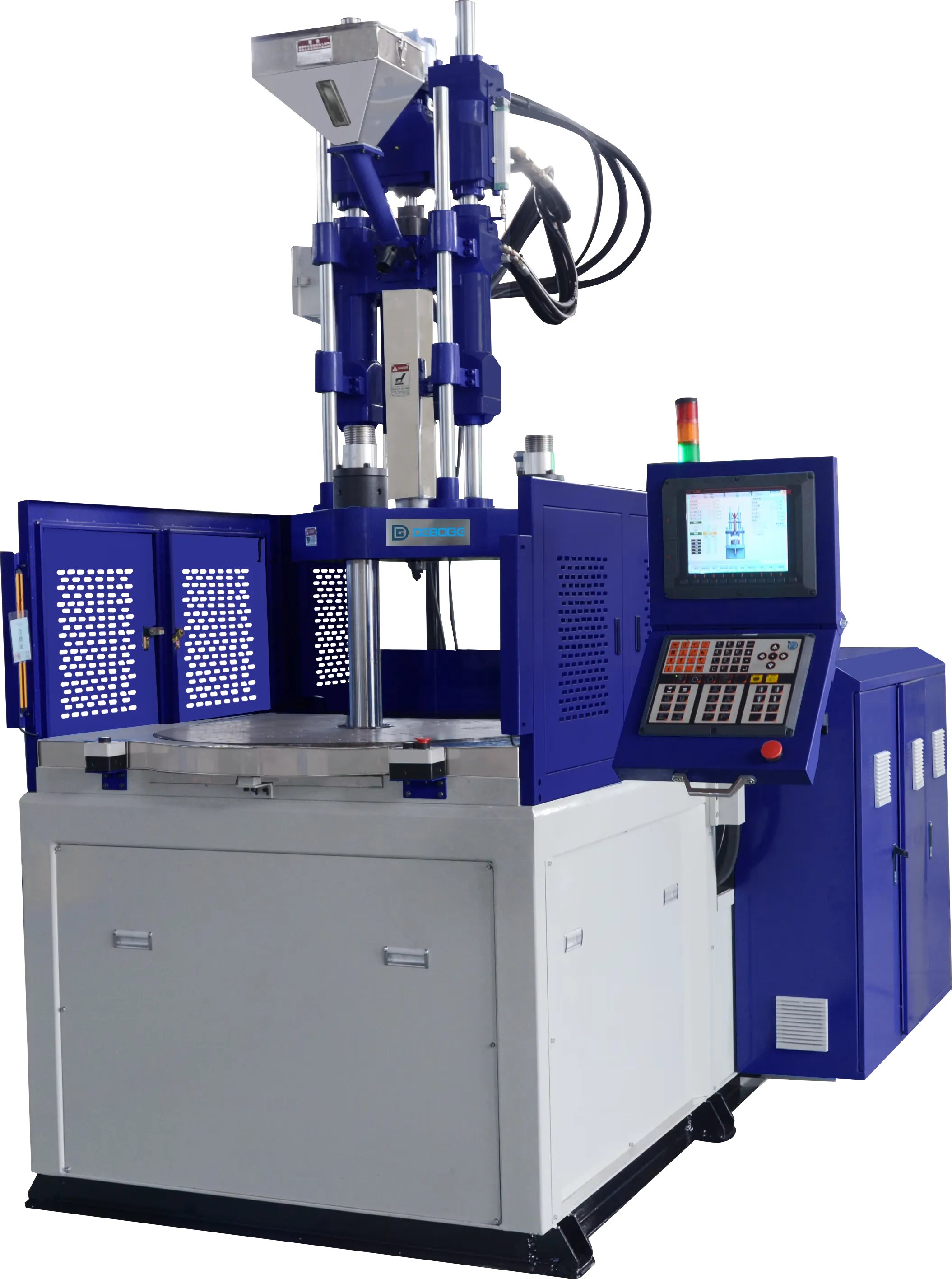
Rotary Table Vertical Injection Molding Machines
Rotary table machines keep loading and molding in motion at the same time, with one station available to the operator while another station runs inside the clamp.
They make sense when insert handling, loading rhythm, and output targets benefit from parallel work rather than a single stationary mold position.
Table Configuration
Parallel loading and molding - every index delivers a finished part
In a rotary table configuration, multiple mold stations are mounted on a rotating disc. The disc indexes - rotates by a fixed angle - to move each station through its sequence: loading, clamping and injection, cooling, and part removal. Different operations happen simultaneously at different stations.
This is the key difference from fixed platen and slide table: rotary does not speed up injection. It eliminates waiting. While one cavity is being injected, the next set of inserts is already being loaded at another station. The result is a steady, continuous output rhythm - particularly valuable for insert molding and overmolding at production scale.
- Continuous production Loading and molding overlap - no idle time waiting for the next insert set
- Multi-station design Configurable 2 - stations for dedicated loading, molding, cooling, and ejection
- Available across all series DA (8), DC (3), DK (4) - 15 rotary models from 300 to 2,100 kN
- Automation-ready Fixed station positions make it straightforward to integrate robots, conveyors, and vision systems
How It Works
Each rotation delivers a finished part - four operations, one disc, zero idle time
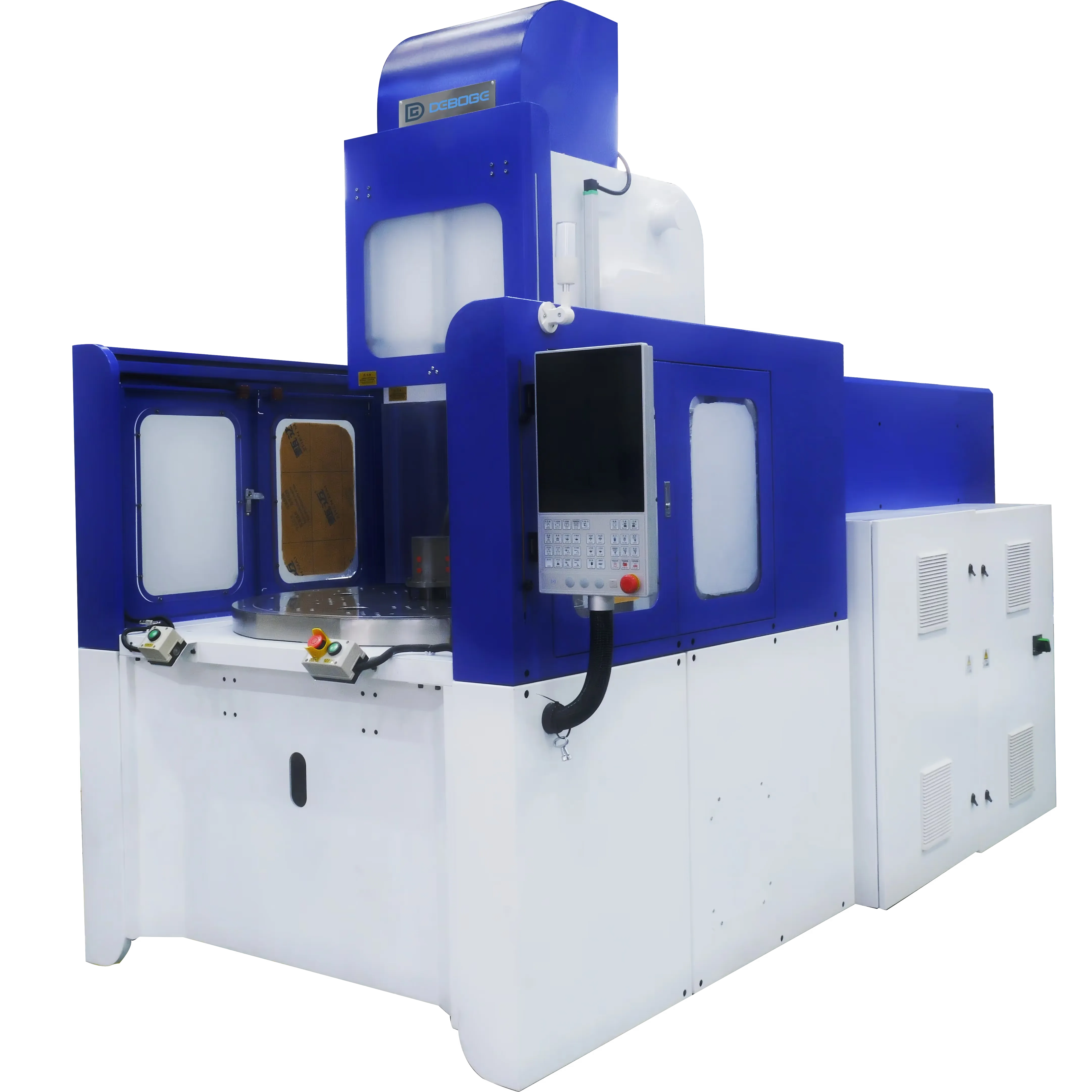
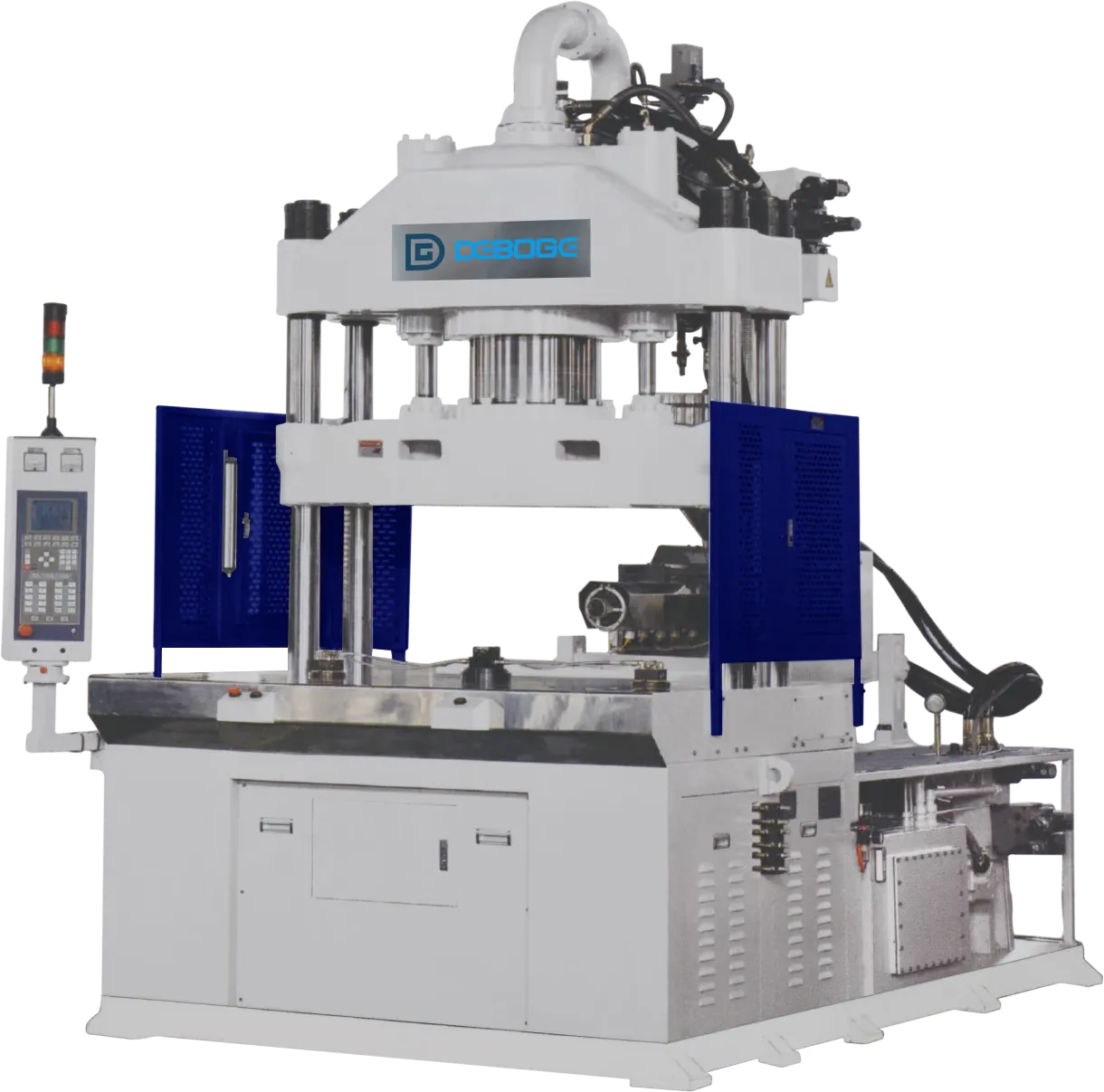
The rotary disc indexes by a fixed angle after each injection cycle. Every station advances to the next position in the sequence. While the mold at Station 2 is clamped and injected, the operator at Station 1 is loading inserts for the next shot, and the part at Station 3 is cooling. No station waits for another to finish - the disc only indexes when every station is ready.
- Station 1 | Loading
- Operator places inserts into the open mold at the loading station while other stations are active.
- Station 2 | Molding
- The mold rotates into clamping position. Upper platen closes. Material is injected.
- Station 3 | Cooling
- After injection, the mold indexes to a cooling station - part solidifies while the next cavity is molded.
- Station 4 | Ejection
- The cooled part is ejected or removed. The empty mold rotates back to the loading station.
Why parallel stations matter
- - Insert molding at volume: While one cavity is molding, the next set of inserts is being positioned. For parts with 6-12 inserts per cavity, the loading time saved per cycle directly multiplies daily output.
- - Multi-operator workflow: Different operators can work at different stations - one handles loading, another handles inspection or packaging at the ejection station. The rotary disc naturally separates responsibilities.
- - Consistent cycle rhythm: Fixed station positions and indexed rotation produce a predictable, repeatable cycle time - important for production planning, quality consistency, and automation integration.
- - Cooling without bottleneck: On sequential machines, cooling time adds directly to cycle time. On a rotary table, a dedicated cooling station lets parts solidify while the next shot is already molding - useful for thicker parts that need longer cooling.
Compatible Series
Rotary table across all three Deboge platforms
Every Deboge vertical molding series includes rotary table models. The right series depends on your part size, shot weight, material, and whether a tie-bar-less structure or horizontal injection benefits your application.
DA Series
Standard Vertical Injection
DA offers 8 rotary models (DA-300R - DA-2100R) with vertical clamping and vertical injection. Rotary disc diameters range from 700 mm to 1,470 mm with customizable station counts.
View series detailsDC Series
Tie-bar-less Vertical Clamping
DC offers 3 rotary models (DC-450R - DC-1200R) with a tie-bar-less open structure. Operators access every station without tie-bars blocking the work area - often reviewed for small, high-precision parts.
View series detailsDK Series
Vertical Clamping | Horizontal Injection
DK offers 4 rotary models (DK-1200R - DK-2100R) with horizontal injection. The side-mounted injection unit stays fixed while the rotary table indexes - larger shot sizes for automotive and industrial rotary molding.
View series detailsEach series page includes complete rotary table specification tables - model numbers, clamp force, disc diameter, station count, shot weight, and machine dimensions. Full 25-parameter data sheets are available on request.
Typical Applications
Rotary table is the go-to for insert molding and overmolding at production scale
When insert loading time is a meaningful portion of the total cycle and output targets are high, the parallel workflow of a rotary table directly increases daily production. These are the applications where rotary table is most commonly selected.
Choosing Your Configuration
When loading time matters, parallel beats sequential
The right table configuration depends on your insert loading workflow. The more time spent on loading relative to molding, the more you benefit from moving up the spectrum toward rotary.
Sequential
Fixed Platen ->
All operations at one station. Lowest complexity. Choose when inserts are simple and accessible without table movement.
Alternating
Slide Table ->
Mold moves out to operator. Single for batch work, double for overlapping load and mold. Good for manual workflows.
Continuous parallel
Rotary Table
Multi-station rotation. Loading, molding, cooling simultaneous. Highest throughput for insert-intensive production.
You are here
Related Machine Information
Frequently Asked Questions About Rotary Table Machines
How does a rotary table machine differ from a slide table machine?
How many stations does a typical rotary table have?
Which applications benefit most from rotary table configuration?
How does rotary table affect overall cycle time and output?
Which series offer rotary table configuration?
Ready to discuss rotary table configuration for your production?
Share your part design, insert type, target output, and preferred station layout so the engineering team can help evaluate rotary table configuration and machine selection for your application.