
Why Insert Loading Time Can Change Machine Selection
Learn why insert loading time affects vertical injection molding machine selection, table configuration, operator workflow, and automation planning.
2026-07-09 | 7 min read | Category: Production Insights
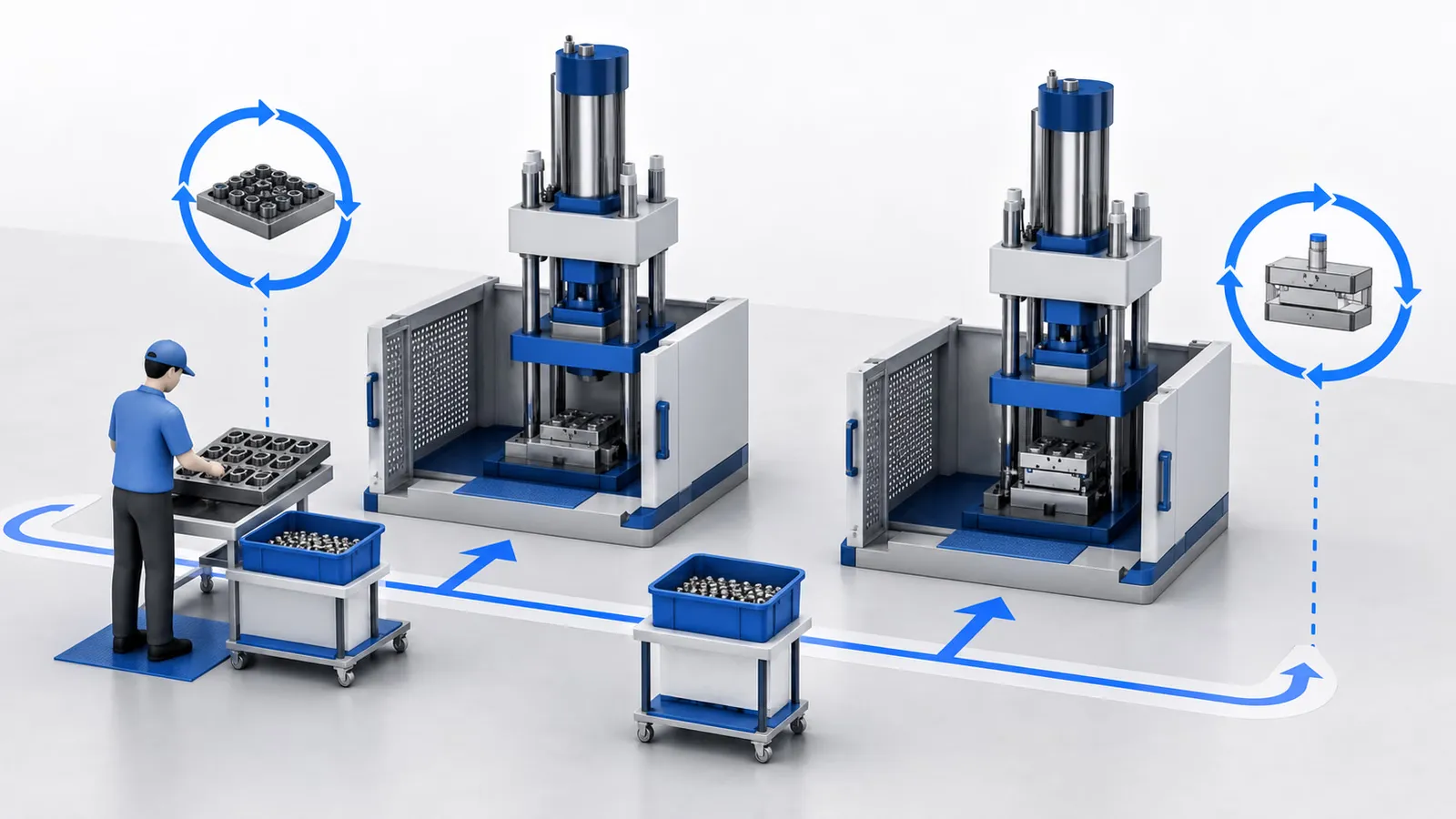
Insert loading time can decide whether a vertical injection molding machine feels efficient or constantly waiting. If the operator takes longer to place inserts than the machine takes to mold the part, the machine structure and table configuration need to support parallel work. This is why loading time should be discussed before choosing fixed platen, slide table, rotary table, or automation-ready layouts.
For the broader selection path, see the machine selection guide.
Loading Time Is Part of the Cycle
Many teams think of cycle time as the machine’s molding time. In insert molding, the real production rhythm also includes placing inserts, checking position, closing the mold, molding, cooling or curing, opening the mold, removing the part, and preparing for the next shot.
If insert loading is quick and simple, a fixed platen workflow may be enough. If loading is complex, the machine may sit idle while the operator prepares the mold. That idle time is not solved by a larger machine. It is solved by choosing a workflow that lets loading and molding happen with less interference.
When Fixed Platen Works
Fixed platen machines keep the lower mold half in the clamping area. This can work well when insert loading is simple, the operator has clear access, and the loading action does not compete heavily with molding time.
Fixed platen should be discussed when:
- The insert is easy to place.
- The operator does not need wide side access.
- The product has a stable and repeatable loading method.
- Automation or robotic removal can reach the mold area clearly.
See fixed platen machines for the machine category.
When Slide Table Helps
A slide table moves the lower mold half out of the clamping area for loading. This gives the operator more open access and can reduce awkward reaching. In a double slide table concept, one station can be loaded while another is in the molding position.
Slide table machines are often discussed when the operator needs more room to place inserts, when the insert position is delicate, or when the loading action benefits from being outside the clamping zone. This is especially relevant for metal insert molding and products with multiple inserts.
See slide table machines for the machine category.
When Rotary Table Becomes Important
A rotary table can support a more continuous workflow. Different stations can handle loading, molding, cooling, and unloading in sequence. The reason to discuss rotary table is not only output. It is the ability to separate work steps so the machine and operator are not always waiting for each other.
Rotary table should be discussed when insert loading is repeated, production volume justifies station-based work, and the mold concept can support the layout. See rotary table machines for details.
When Automation Should Enter the Conversation
Automation is not a decoration added at the end. If automatic insert loading, part removal, vision checking, or downstream handling is expected, machine layout should be discussed with automation in mind from the beginning.
An automation-ready vertical molding machine discussion should include access direction, signal requirements, fixture design, safety guarding, and how the automation will interact with the mold. These details need project-specific review.
Practical Questions to Prepare
Before asking for a machine recommendation, record the loading process:
- How many inserts are placed per cycle?
- Are inserts easy to orient by hand?
- Does the operator need front access, side access, or open access around the mold?
- Is the loading action shorter than the molding time?
- Could a fixture or automation system improve consistency?
- Does the molded part need careful removal?
These answers help connect production workflow to machine structure. If the loading time is uncertain, send videos or photos of the current process through Contact Deboge. Visual workflow information is often more useful than a short written description.
Related Reading
Have a question about this topic?
Contact Deboge engineering for technical questions specific to your application and production requirements.