
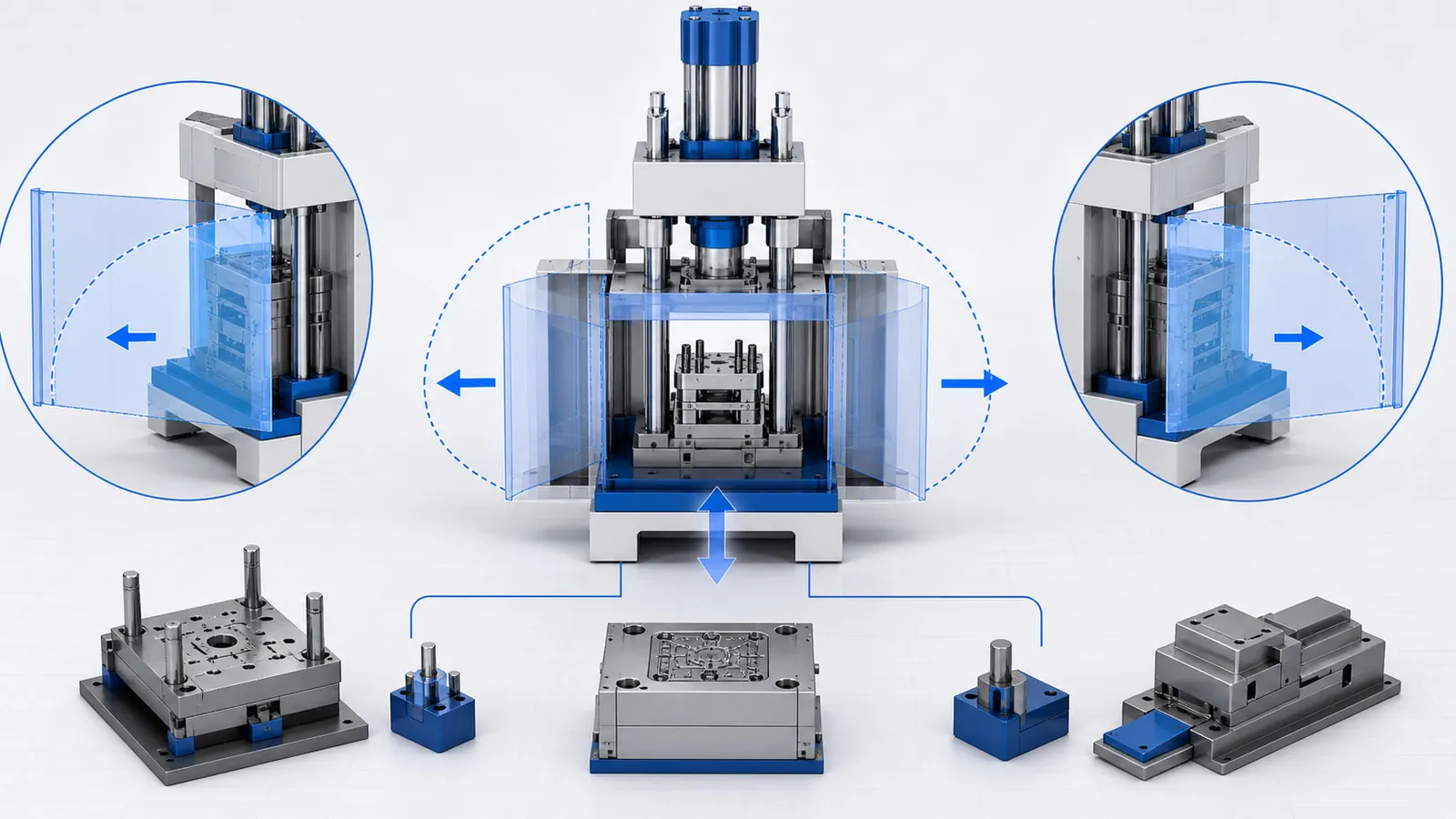
Difficult Part Removal: Mold, Ejection, and Handling Checks
Diagnose difficult part removal by reviewing mold release, cooling or curing, undercuts, insert position, ejection timing, operator access, and fixture support.
2026-07-12 - 8 min diagnostic read - Category: Process Issues
Difficult part removal slows the cycle and can damage parts, inserts, operators, fixtures, or the mold. The cause may be mold release, undercut geometry, cooling or curing condition, ejection support, insert position, operator access, or table layout.
Quick Answer
Review removal as part of the full workflow, not as an afterthought. A part that fills correctly can still fail production if removal is slow, unsafe, or inconsistent. Check when the part sticks, where force is applied, and whether the operator can reach the part without awkward movement.
What You May See
- The part sticks to the mold, insert, core, or fixture.
- Operators need extra force, twisting, tools, or repeated attempts to remove the part.
- Parts deform, crack, mark, or expose inserts during removal.
- Cycle time changes because removal time is inconsistent.
- The problem changes with cooling or curing time, mold cleaning, or operator side.
Likely Cause Areas
- Part geometry, undercuts, texture, ribs, or shrinkage may hold the part on the mold.
- Cooling or curing time may not allow the part to become stable before removal.
- Insert position or metal surface condition may create extra holding force.
- Ejection or release support may not match the part shape.
- Operator access may be restricted by mold height, table position, fixture layout, or part orientation.
- Residue, wear, or surface condition may increase sticking over time.
Safe Checks Before Adjustment
Stop automatic operation if movement, alarm, guarding, or operator safety is uncertain. Do not place hands in the mold, table, injection, or guarded area while movement is possible. Use photos, controller screenshots, cycle logs, and safe observation before changing several settings.
Diagnosis Path
- Record where the part sticks and what motion releases it.
- Compare removal difficulty immediately at mold open and after added cooling or curing time.
- Check whether the problem follows one cavity, one insert type, one station, or one operator side.
- Inspect part marks, deformation, cracks, or exposed inserts after removal.
- Review ejection, release, mold surface, and residue condition under safe stopped conditions.
- Observe operator reach and hand position without placing anyone near moving areas.
- Record cycle time impact and whether removal delay creates later defects.
- Consider fixture or table layout changes only after the sticking location is clear.
Evidence to Collect
| Check | Why It Matters | Evidence to Collect |
|---|---|---|
| Sticking location | The location points to mold, insert, or part geometry cause | Marked photos of part and mold area |
| Removal motion | Force direction shows whether access or ejection is the issue | Safe video and operator notes |
| Cooling or curing time | Part stability affects release and deformation | Cycle log and sample comparison |
| Surface condition | Residue or wear can increase sticking | Safe mold inspection photos |
| Part damage | Damage shows whether removal is affecting product acceptance | Photos of marks, cracks, or deformation |
What Not to Change Too Quickly
- Do not normalize unsafe hand positions or excessive force.
- Do not treat removal only as an operator speed issue.
- Do not use improvised tools that may damage the mold or part.
- Do not evaluate cycle time without including removal time.
When to Contact Deboge
Contact Deboge when part removal affects cycle time, part acceptance, or operator access. Send mold and part photos, removal location, table type, cycle timing, machine model, and a safe removal video if available.
Related Reading
Related Reading
Related Questions
Why is difficult part removal a process issue, not only a mold issue?
Removal depends on mold design, part geometry, cooling or curing, ejection support, operator access, table layout, and handling sequence.
Can table configuration affect part removal?
Yes. Fixed platen, slide table, and rotary table layouts change where the operator accesses the mold and how removal work fits into the cycle.
What should be recorded during removal review?
Record where the part sticks, the release motion, cycle timing, part damage, mold surface condition, operator access, and whether the issue follows a station.
When should removal be reviewed before automation?
Before discussing automation, confirm that the part can release consistently, that orientation is controlled, and that access and fixtures support repeatable handling.
Need help with this issue?
Send the machine model, material, mold or insert details, defect photos, alarm screenshots, and recent changes. Deboge can review the information and suggest the next diagnostic step.