
What Is Part Removal in Vertical Injection Molding?
Understand part removal in vertical injection molding, why unloading can affect cycle stability, and how removal method influences machine and mold discussion.
2026-07-11 | 8 min read | Category: Process and Workflow Concepts
Quick Answer
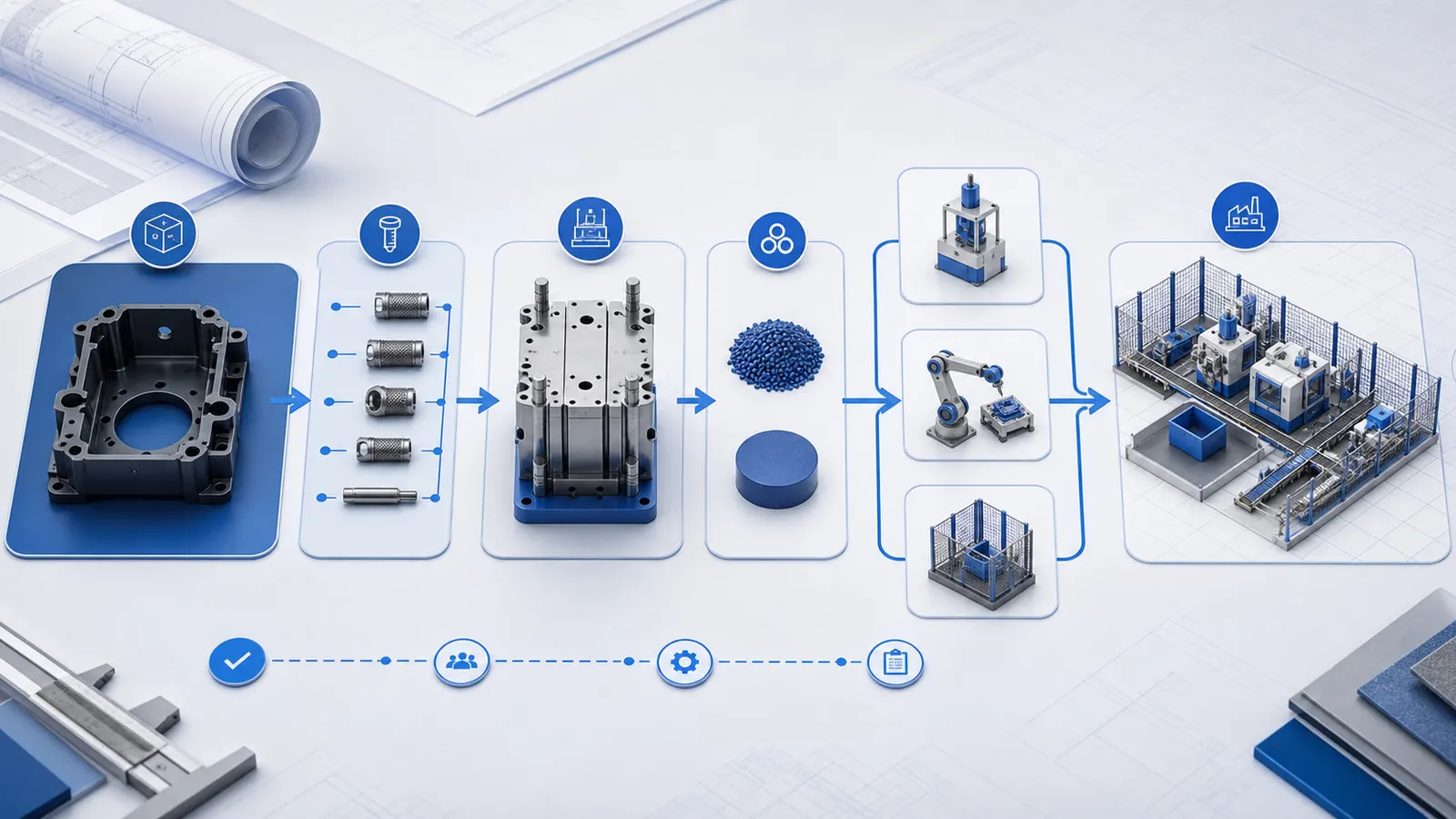
Part removal is the step of taking the molded part out of the mold after opening, including manual removal, ejector assistance, robot picking, runner handling, and inspection.
Why should part removal be reviewed before choosing a machine? Start with the workflow, not only the machine name. The term helps a project team discuss the part, material, mold, loading method, removal method, and production target with the same meaning.
Use this page as a concept reference, not as a final machine specification, mold design rule, or processing parameter recommendation.
What Part Removal Means in a Molding Project
Many projects focus on loading and injection, but removal can become the hidden bottleneck. A finished part may stick, flex, retain heat, include a cable, hold a metal insert, or require careful handling to avoid damage. If the removal method is slow or unclear, the cycle becomes unstable. If removal requires awkward access, the operator may delay the next loading step. In automation-ready projects, removal also affects robot path, gripper design, inspection, and downstream placement.
Part removal belongs in the machine discussion because the cycle does not end when injection finishes. Review where the part sticks, how it is supported, whether it can bend or scratch, and whether the operator or automation system can remove it consistently.
Why It Matters for Machine Selection
Part removal affects mold access, ejector discussion, table configuration, robot access, safety guarding, and whether the process can maintain the expected production rhythm.
| Review point | Why it matters |
|---|---|
| Part shape | Deep features, undercuts, flexible sections, and inserts can make removal more difficult. |
| Material behavior | Soft, hot, cured, or brittle parts may need different handling. |
| Removal direction | Must match mold opening, table position, and operator or robot access. |
| Downstream handling | Parts may need trimming, inspection, tray placement, or cooling after removal. |
How to Compare Related Options
The best option depends on the actual part and production method. Use the comparison below as a review map, then confirm the project details with drawings, samples, material information, and mold concept.
| Concept | Practical meaning |
|---|---|
| Manual removal | Flexible but depends on operator reach and part temperature or stiffness. |
| Ejector-assisted removal | Needs mold and machine coordination; not a substitute for safe access. |
| Robot removal | Requires approach path, gripper design, signal exchange, and guarding. |
| Station-based removal | May be paired with rotary or slide table workflows. |
What to Check Before Requesting a Recommendation
Before asking Deboge to recommend a machine structure, collect the information that explains the real production task. Clear project evidence is more useful than a broad keyword.
| Review point | Why it matters |
|---|---|
| Finished part sample or drawing | Shows geometry, flexible areas, insert position, and removal difficulty. |
| Known sticking or damage issues | Photos help separate mold, material, and handling causes. |
| Removal method | Manual, ejector, air, robot, or fixture-assisted removal. |
| Downstream process | Inspection, trimming, cooling, tray placement, or packing after removal. |
Common Mistakes to Avoid
- Assuming a molded part will fall out cleanly.
- Planning loading time but ignoring removal and inspection time.
- Choosing automation before checking whether the part can be gripped safely.
- Ignoring heat, flexibility, or insert weight during removal.
How This Connects to Other Resource Pages
Knowledge Base pages explain the concept. Machine pages show available machine structure directions. Guides help compare options when a project is closer to inquiry. Troubleshooting and material pages help when an existing process already has symptoms.
- Insert Loading
- Cycle Time vs Loading Time
- Difficult Part Removal Troubleshooting
- Automation-ready Vertical Molding Machines
FAQ
Why is part removal part of machine selection?
Removal affects access, cycle rhythm, safety, table configuration, and automation planning.
Can ejectors solve every removal problem?
No. Ejectors help in some molds, but material behavior, part geometry, mold finish, and handling method still matter.
When should robot removal be discussed?
Discuss it when manual removal is slow, unsafe, inconsistent, or difficult to scale, and when the part shape can support reliable gripping.
What evidence helps troubleshoot removal problems?
Send part photos, mold open photos, removal video if safe, material information, and when the sticking or damage appears.
Related Reading
Need technical information specific to your application?
Deboge engineering can answer your machine structure, configuration, and process questions directly.