
Cycle Time vs Loading Time in Vertical Molding
Understand cycle time and loading time in vertical molding, and why machine selection should review the full production workflow.
2026-07-11 | 8 min read | Category: Process and Workflow Concepts
Quick Answer
Cycle time is the total repeated production cycle. Loading time is the part of the cycle used to place inserts, substrates, or parts before the mold closes.
Why can loading time be more important than injection time in vertical molding? Start with the workflow, not only the machine name. The term helps a project team discuss the part, material, mold, loading method, removal method, and production target with the same meaning.
Use this page as a concept reference, not as a final machine specification, mold design rule, or processing parameter recommendation.
What Cycle Time and Loading Time Means in a Molding Project
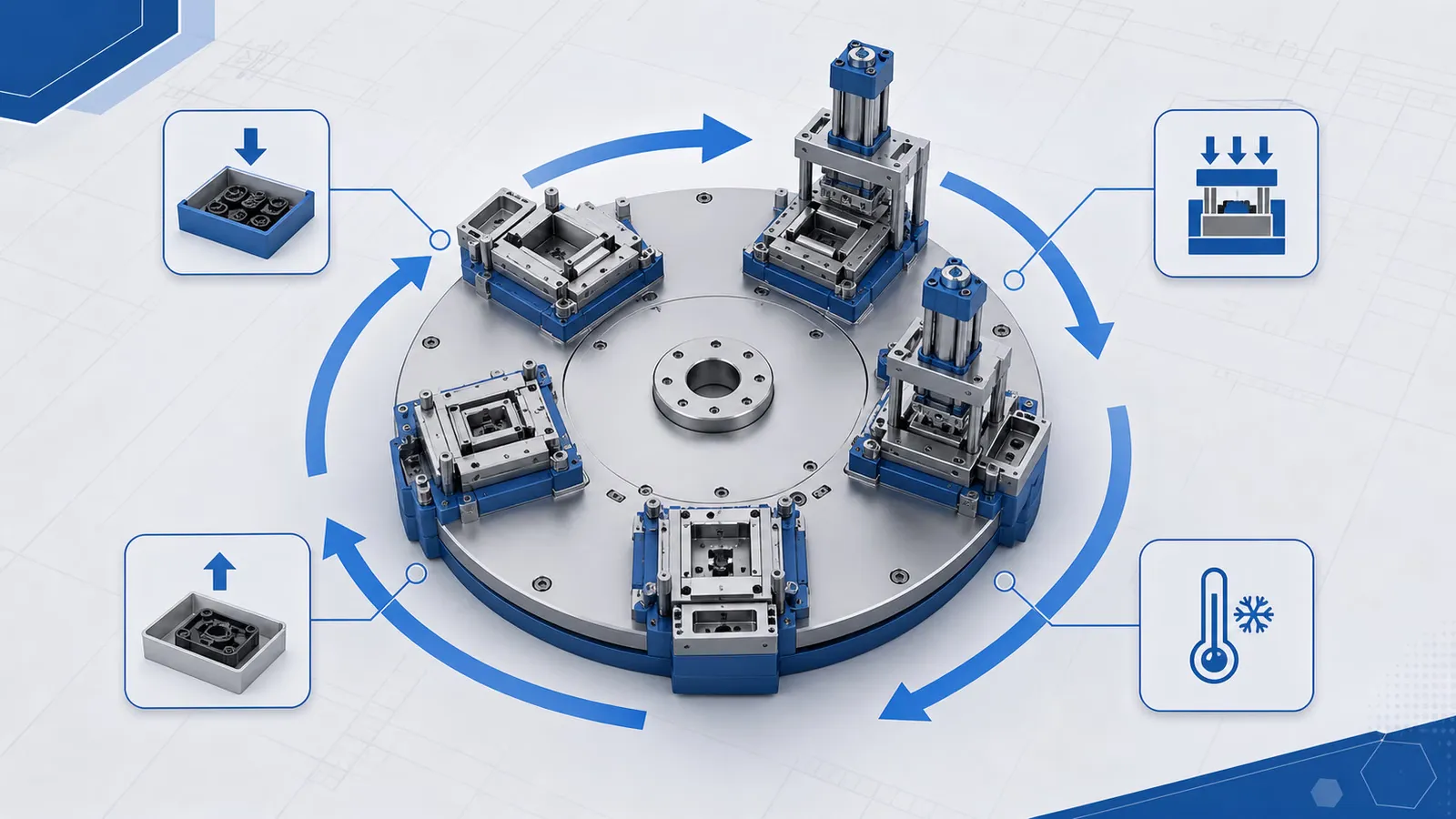
Vertical injection molding often includes human or automated work before each shot. Inserts must be placed, checked, and sometimes held by fixtures. Finished parts must be removed. Cooling or curing may take time depending on material and mold. If the team only compares machine speed or injection time, the real production bottleneck can be missed. A rotary table or slide table may help when loading and molding can be separated, but it only helps if the cycle breakdown supports that structure.
Use cycle time and loading time to describe the full production rhythm, not only the seconds shown on the controller. A useful review includes insert placement, mold close, injection, cooling or curing, opening, part removal, checking, and preparation for the next cycle.
Why It Matters for Machine Selection
The full workflow should be broken into loading, mold close, injection, holding, cooling or curing, mold open, part removal, inspection, and reset. Machine configuration decisions should follow this breakdown.
| Review point | Why it matters |
|---|---|
| Insert loading time | May dominate output when many inserts or careful positioning are required. |
| Cooling or curing time | Can decide whether parallel loading positions are useful. |
| Part removal time | Often becomes a bottleneck when parts are hot, flexible, or difficult to release. |
| Operator rhythm | Shows whether the process can be repeated safely and consistently. |
How to Compare Related Options
The best option depends on the actual part and production method. Use the comparison below as a review map, then confirm the project details with drawings, samples, material information, and mold concept.
| Concept | Practical meaning |
|---|---|
| Short loading, long molding time | Rotary or slide movement may be less important unless access is needed. |
| Long loading, shorter molding time | Table configuration may help reduce waiting time. |
| Manual loading bottleneck | Fixture, table movement, or semi-automation may be reviewed. |
| Automation bottleneck | Robot path, feeding, signals, and removal sequence need review. |
What to Check Before Requesting a Recommendation
Before asking Deboge to recommend a machine structure, collect the information that explains the real production task. Clear project evidence is more useful than a broad keyword.
| Review point | Why it matters |
|---|---|
| Cycle breakdown | Separate loading, injection, cooling or curing, removal, inspection, and reset. |
| Current process video | If production exists, a safe video can show where time is lost. |
| Material and mold notes | Cooling, curing, heating, and release behavior affect real cycle planning. |
| Production target | Hourly, shift, or daily output expectation and number of operators. |
Common Mistakes to Avoid
- Estimating output from injection time alone.
- Ignoring the time needed to inspect insert position.
- Assuming rotary table helps without a cycle breakdown.
- Forgetting startup scrap, changeover, and operator handover time in real production planning.
How This Connects to Other Resource Pages
Knowledge Base pages explain the concept. Machine pages show available machine structure directions. Guides help compare options when a project is closer to inquiry. Troubleshooting and material pages help when an existing process already has symptoms.
- Insert Loading
- Rotary Table Structure
- Manual Semi-automatic and Automatic Loading
- Rotary Table Production Planning
FAQ
Is cycle time the same as injection time?
No. Cycle time includes loading, mold movement, injection, cooling or curing, opening, removal, and reset steps.
Why does loading time affect table selection?
If loading time is a bottleneck, slide table or rotary table structures may help create a clearer or parallel loading workflow.
Can Deboge estimate output from a product photo?
A photo is useful but not enough. Output discussion needs material, mold concept, loading method, removal method, and target workflow.
What should be measured in an existing process?
Record loading time, injection and holding time, cooling or curing time, mold open time, removal time, inspection time, and delays.
Related Reading
Need technical information specific to your application?
Deboge engineering can answer your machine structure, configuration, and process questions directly.