
What Is Insert Loading?
Understand insert loading in vertical molding, why it affects cycle efficiency and part quality, and what loading details should be prepared for machine review.
2026-07-11 | 8 min read | Category: Process and Workflow Concepts
Quick Answer
Insert loading is the step of placing metal, plastic, cable, textile, or other components into the mold before injection.
Why can insert loading decide the machine structure? Start with the workflow, not only the machine name. The term helps a project team discuss the part, material, mold, loading method, removal method, and production target with the same meaning.
Use this page as a concept reference, not as a final machine specification, mold design rule, or processing parameter recommendation.
What Insert Loading Means in a Molding Project
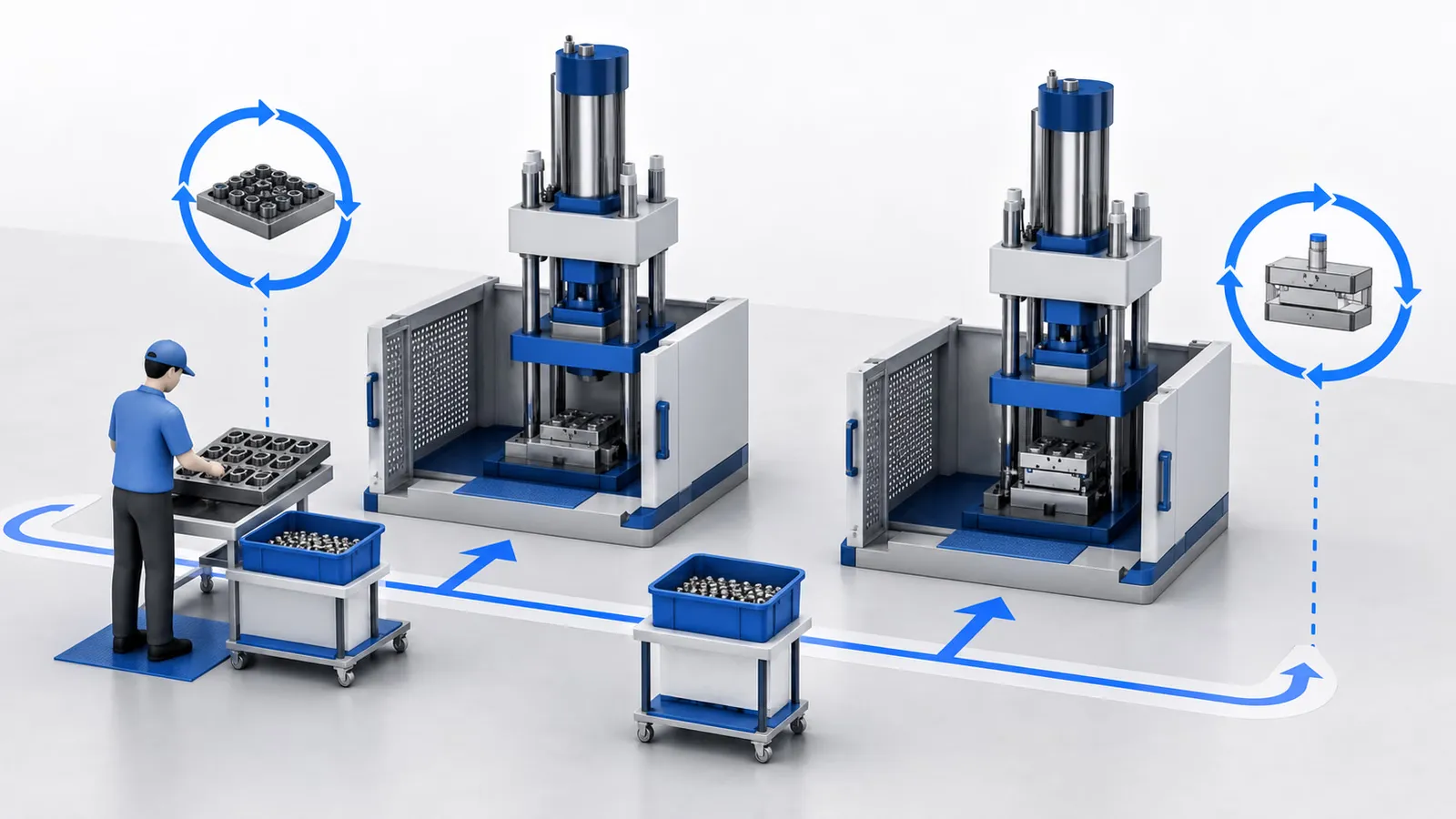
Insert loading is often the most human and most variable part of an insert molding process. The machine can only produce stable parts when inserts are placed correctly and repeatably. If the loading step is slow, hard to see, unsafe, or inconsistent, the cycle becomes unstable even if the clamping and injection capability are adequate. This is why insert loading must be discussed before choosing fixed platen, slide table, rotary table, tie-bar-less access, or automation-ready layouts.
Insert loading should be reviewed before the machine model is compared. The loading method affects mold access, fixture design, table movement, safety position, cycle rhythm, and whether manual, semi-automatic, or automatic loading is realistic for the project.
Why It Matters for Machine Selection
The loading method influences mold access, table configuration, safety devices, cycle timing, and whether fixtures or robots should be included in the project discussion.
| Review point | Why it matters |
|---|---|
| Insert count | More inserts usually increase loading time and checking requirements. |
| Insert orientation | Orientation-sensitive parts may need fixtures, visual checks, or automation support. |
| Access direction | Determines whether front access is enough or side access is needed. |
| Operator rhythm | Shows whether loading time is the bottleneck compared with cooling or curing time. |
How to Compare Related Options
The best option depends on the actual part and production method. Use the comparison below as a review map, then confirm the project details with drawings, samples, material information, and mold concept.
| Concept | Practical meaning |
|---|---|
| Manual loading | Flexible and common for early production, but depends on operator consistency. |
| Fixture-assisted loading | Improves positioning but adds mold and access requirements. |
| Semi-automatic loading | Combines operator work with devices or staged components. |
| Automatic loading | Requires early planning for feeding, robot access, signals, and guarding. |
What to Check Before Requesting a Recommendation
Before asking Deboge to recommend a machine structure, collect the information that explains the real production task. Clear project evidence is more useful than a broad keyword.
| Review point | Why it matters |
|---|---|
| Insert photos or samples | Show shape, orientation, size, and handling difficulty. |
| Loading sequence | Explain each step before the mold closes. |
| Positioning method | Manual placement, fixture, magnet, pin, nest, or automation. |
| Known problems | Insert shift, exposed insert, slow loading, missing insert, or operator fatigue. |
Common Mistakes to Avoid
- Treating insert loading as an operator detail instead of a machine selection factor.
- Ignoring the time needed to check insert position before mold close.
- Planning automation without reviewing insert orientation and feeding difficulty.
- Only measuring injection time while the real bottleneck is loading.
How This Connects to Other Resource Pages
Knowledge Base pages explain the concept. Machine pages show available machine structure directions. Guides help compare options when a project is closer to inquiry. Troubleshooting and material pages help when an existing process already has symptoms.
- Insert Molding
- Cycle Time vs Loading Time
- Manual Semi-automatic and Automatic Loading
- Insert Loading Time and Machine Selection
FAQ
Why is insert loading important in machine selection?
It affects mold access, table configuration, cycle rhythm, safety, and whether fixtures or automation are needed.
Can insert loading be reviewed from a part photo only?
A photo helps, but the loading sequence, insert orientation, mold concept, and target output are also needed.
When should automation be discussed for insert loading?
Discuss automation when loading is slow, inconsistent, unsafe, too repetitive, or difficult to scale manually.
What evidence is useful for an existing process?
Send a short loading video, cycle breakdown, defect photos, and notes about where the operator loses time.
Related Reading
Need technical information specific to your application?
Deboge engineering can answer your machine structure, configuration, and process questions directly.