
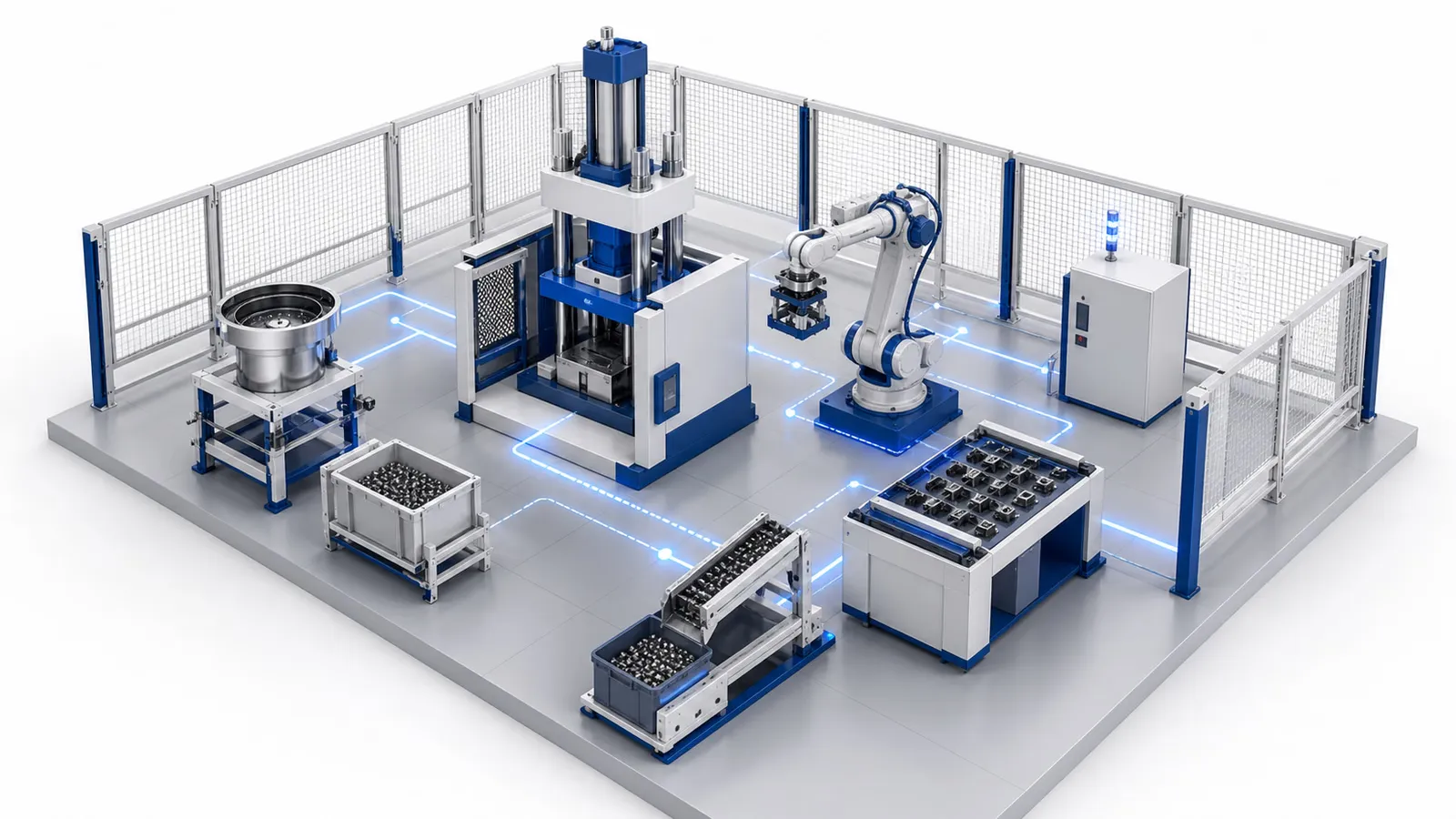
Manual vs Semi-automatic vs Automatic Loading Guide
Choose manual, semi-automatic, or automatic loading by reviewing inserts, access, repeatability, cycle rhythm, labor, and automation plans.
2026-07-11 | 9 min read | Category: Choose by Production Requirement
Loading method affects table configuration, safety planning, labor use, repeatability, and future automation. Manual, semi-automatic, and automatic loading are not simple levels of quality; they are different workflow choices.
This guide helps compare loading methods for vertical molding projects. The right level depends on insert handling, cycle rhythm, production volume, fixture design, and how much process responsibility should be automated.
Quick Answer
Choose manual loading when volume and complexity are moderate and operator placement is practical. Review semi-automatic loading when fixtures or assist devices improve repeatability. Review automatic loading when volume, safety, repeatability, or labor planning justifies a controlled workcell.
When This Guide Is Most Useful
Use this guide when loading time, operator movement, repeatability, or automation investment is part of the machine selection discussion.
Selection Path
Measure the loading task, not only the cycle time
Injection time may be short while loading time controls real output. Record how many inserts are loaded, how they are oriented, and how often the operator must check placement.
Review repeatability and safety
If the process depends on precise loading, assist devices or automation may reduce variation. Safety devices, access direction, and operator posture should also be reviewed.
Match table layout to loading method
Manual loading may work with fixed platen or slide table. Semi-automatic and automatic workflows may need station separation, fixture presentation, or a rotary table.
Plan for future automation without overbuilding
A project can start manual and leave space for automation later. The goal is to avoid blocking a realistic future workcell, not to add automation that the project does not need.
Decision Points to Review
| Review point | Why it matters | What to prepare |
|---|---|---|
| Insert complexity | Small, similar, flexible, or multi-piece inserts can slow manual loading. | Insert count, photos, and orientation requirements. |
| Loading time | Loading time can control output more than injection time. | Observed or estimated loading steps and timing. |
| Repeatability | Variation in placement can create defects or unstable output. | Fixture concept, operator checks, and quality requirements. |
| Future automation | Automation affects table, access, signals, and safety planning. | Robot or assist-device expectations. |
How to Compare Common Options
| Option | When it may fit | What to verify |
|---|---|---|
| Manual loading | Lower volume, flexible projects, simple insert placement, or early production. | Operator access, safety, and repeatability. |
| Semi-automatic loading | Assist devices or fixtures can improve consistency without a full workcell. | Interface, fixture movement, and responsibility boundaries. |
| Automatic loading | Volume, repeatability, or labor planning justifies a controlled loading system. | Part feeding, robot path, signals, guarding, and recovery process. |
Information to Prepare Before Asking for a Recommendation
| Information | Why Deboge needs it |
|---|---|
| Loading step description | It reveals whether manual handling is practical. |
| Insert samples | Handling difficulty cannot be judged from names alone. |
| Target output | Automation value depends on production rhythm and volume. |
| Factory labor and layout plan | Operator availability and workcell space affect the decision. |
Common Mistakes to Avoid
- Treating automation as automatically better than a well-designed manual workflow.
- Ignoring loading time when comparing machine proposals.
- Choosing a table before deciding how inserts will be presented.
- Planning automation without recovery steps for misloads, alarms, or part removal issues.
How This Guide Connects to Other Resources
Use this guide with the automation-ready guide when future workcell integration matters. For insert-specific projects, connect it to insert molding and metal insert molding guides.
Related Reading
- Manual, Semi-automatic, and Automatic Loading
- Insert Loading
- Cycle Time vs Loading Time
- Automation-ready Machine Selection Guide
FAQ
Is automatic loading always the best choice?
No. Automatic loading should be justified by volume, repeatability, safety, labor planning, and workcell feasibility.
When is semi-automatic loading useful?
Semi-automatic loading can help when fixtures, slides, sensors, or assist devices improve repeatability without requiring a full robot workcell.
Why does loading time matter for machine selection?
Loading time can define the real production rhythm and may determine whether fixed platen, slide table, rotary table, or automation should be reviewed.
Can a machine be selected for manual loading now and automation later?
Yes, but future automation should be discussed early so table access, signals, safety, and layout do not block later changes.
Related Reading
Ready to confirm a machine selection?
Send your product details, mold specs, and production requirements. Deboge engineering will review and recommend a specific configuration.